
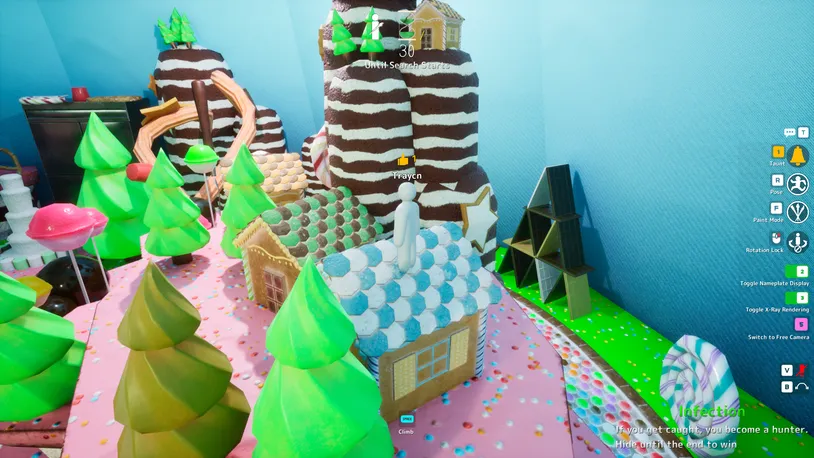
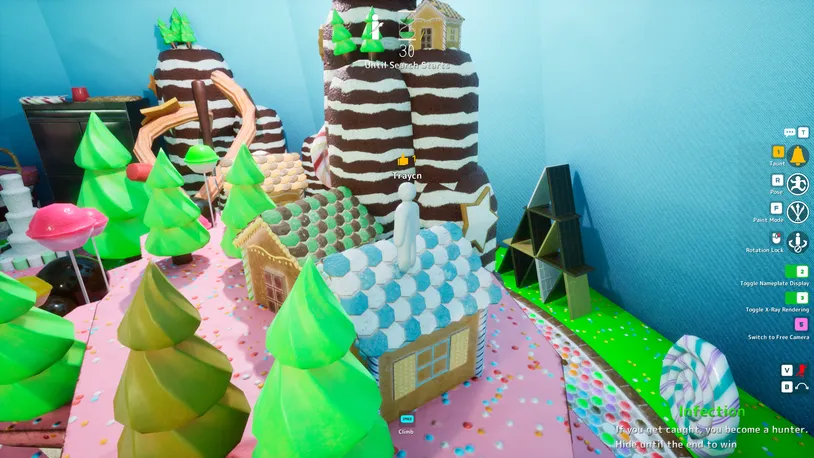
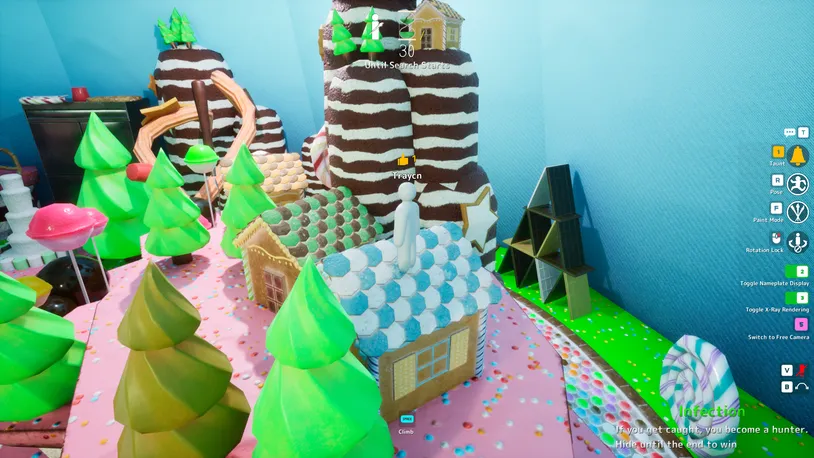
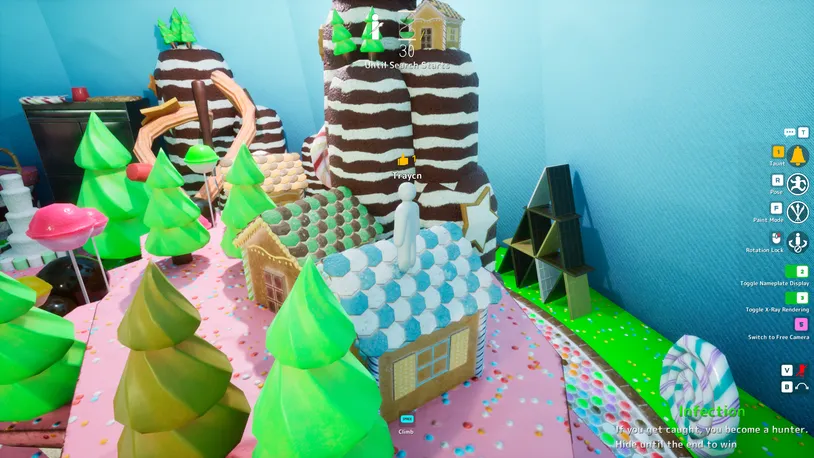
Sugarland is a large, saturated candy environment — gumdrops, gingerbread walls, chocolate hills, and open centre piles. Bright lighting punishes flat one-colour paint and exposed limbs; local shadow sampling matters more than picking a favourite candy colour.
Read the route, identify the likely approach angle, then test paint, pose, and outline in the room you are playing.
What to practice here
Start on one broad candy plane (mountain face, house wall, or gumdrop pile) and build a low wide silhouette. Add a shadow Spoid from the same material before any stripe or sprinkle detail.
Landmark prompts
Use these prompts to inspect the room from both the Hider and Seeker point of view.
| Landmark | Hider question | Seeker question | Note |
|---|---|---|---|
| Candy houses & chocolate hill | Can the pose match roof or wall height from the approach angle? | Is there an extra block breaking the roof rhythm? | Route prompt |
| Centre gumdrop piles | Can the body read as one mound scale, not a standing shape? | Does one pile have the wrong width or height in the row? | Route prompt |
| Tall corner locker | Can you stay low beside the locker instead of mimicking its full height? | Does a vertical edge appear where the locker row stays flat? | Practice note |
| White cake & tree | Can the outline follow the trunk line or cake tier, not float above it? | Does the tree crown or cake top gain a human-width bump? | Route prompt |
| Gingerbread house row | Can you fit between house widths without adding a new “building” shape? | Is one gap in the row unusually wide or tall? | Practice note |
Study routes on Sugarland
Use these examples to identify prop families, approach angles, and outline breaks, then adapt the idea to the room you are playing.
How to turn a study into a usable hide
- Bright maps expose limb edges before hue errors — check hands and feet against the local value.
- Chocolate and gingerbread are separate material families; do not Spoid across both in one hide.
- Centre piles draw Seeker attention — succeed with scale first, not with louder paint.
Hider decision rule
- Choose the backdrop before opening the paint tools.
- Match the largest visible surface first, then use pose to reduce the body outline.
- Spend the last moments checking the edges a Seeker will see first, not adding tiny decoration.
- Stop adjusting once the hunt begins; movement can undo a convincing disguise.
Seeker reading rule
Ignore loud hues at first — compare scale on gumdrop piles and house roof lines. A convincing palette still fails when the outline adds height in a flat field.
Three-round practice plan
- Round one: choose one broad backdrop and judge only whether the silhouette is the wrong height, width, or direction.
- Round two: keep the same area but compare a local light and shadow tone; avoid adding a complicated pattern.
- Round three: approach the area as a Seeker from the opposite direction and name the first visual clue that breaks the disguise.
Common failure patterns
- Copying a clip or landmark without checking the current layout.
- Matching a colour from another part of the room instead of the final local surface.
- Adding detail before the pose and broad outline make sense.
- Treating one spot as permanently safe without retesting it.
Post-round review questions
- What did the Seeker see first: movement, an outline, scale, or colour?
- Would the same idea survive a reverse approach angle?
- Did the current map layout differ from what you expected?
Patch note
Added in v1.4.0 alongside Penguin Hotel expansion. Treat viral “perfect candy” clips as ideas to test, not fixed coordinates.